
Don’t Just Memorize. Visualize.
Here is how a Senior Developer understands Encapsulation.
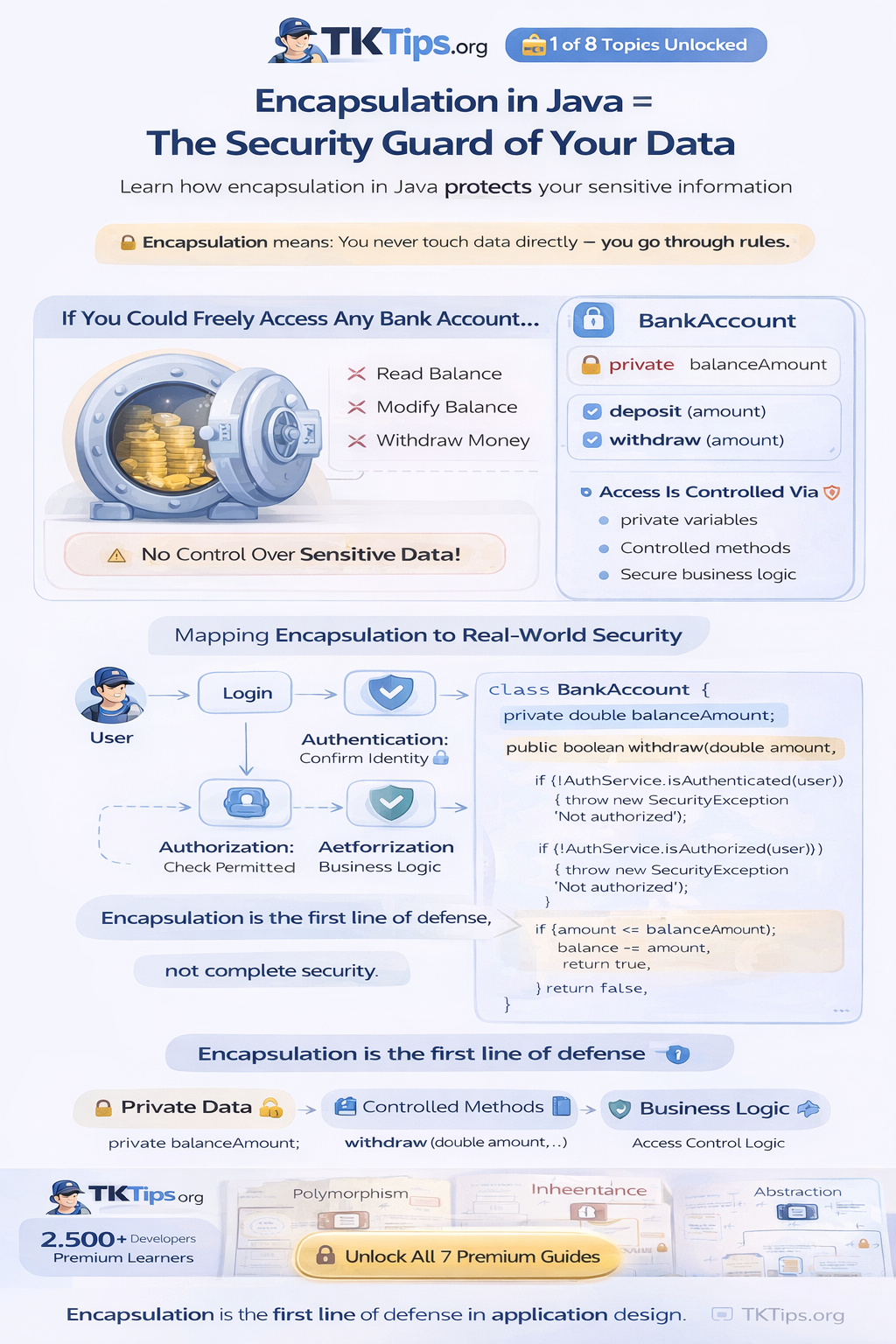
What is Encapsulation? (For Beginners)
Simple Definition: Encapsulation is like putting your sensitive data inside a secure vault and giving people specific keys to access it, rather than letting anyone walk in freely.
Banking Analogy
Your bank balance is private. You can’t just walk into the bank vault. You need to go through the teller who verifies your identity first.
Medicine Analogy
Dangerous medicines are in child-proof bottles. You need to press and twist (the “method”) to access them, not just open freely.
House Analogy
Your house has private rooms. Guests use the front door (public method) and can only enter rooms you allow (controlled access).
In Java, we use private for sensitive data and public methods with logic checks to control how that data is accessed or modified.
What’s Wrong with Basic “Getters & Setters”?
Many beginners think encapsulation means just making variables private and adding getBalance() and setBalance() methods. This is incomplete protection!
public class BankAccount {
    private double balance;

    public void setBalance(double newBalance) {
        this.balance = newBalance;
    }

    public double getBalance() {
        return balance;
    }
}
🚨 Critical Issues
- Anyone can set balance to negative amounts
- No user authentication required
- No transaction logging or audit trail
- No overdraft protection or limits
- Reflection-based access still possible
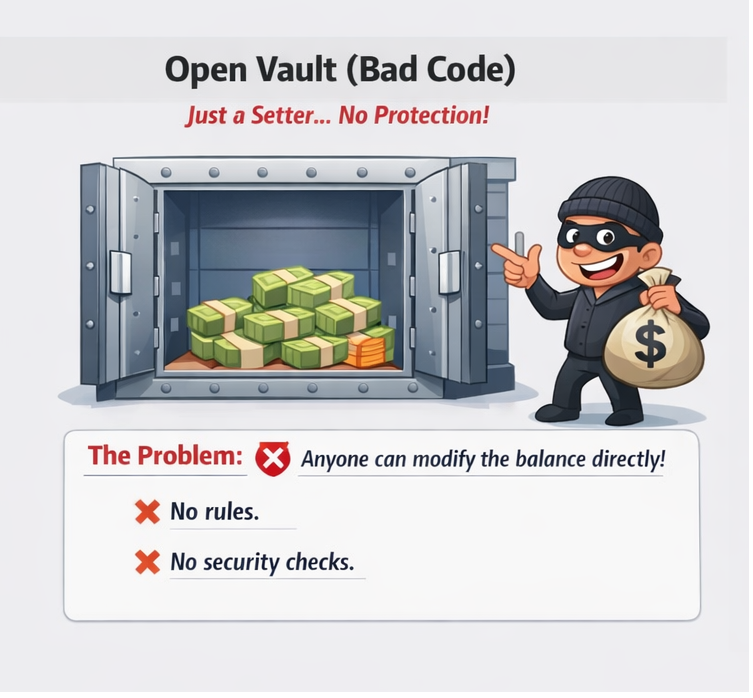
❌ Bad Encapsulation
Open vault with no security. Anyone can directly access and modify the data.
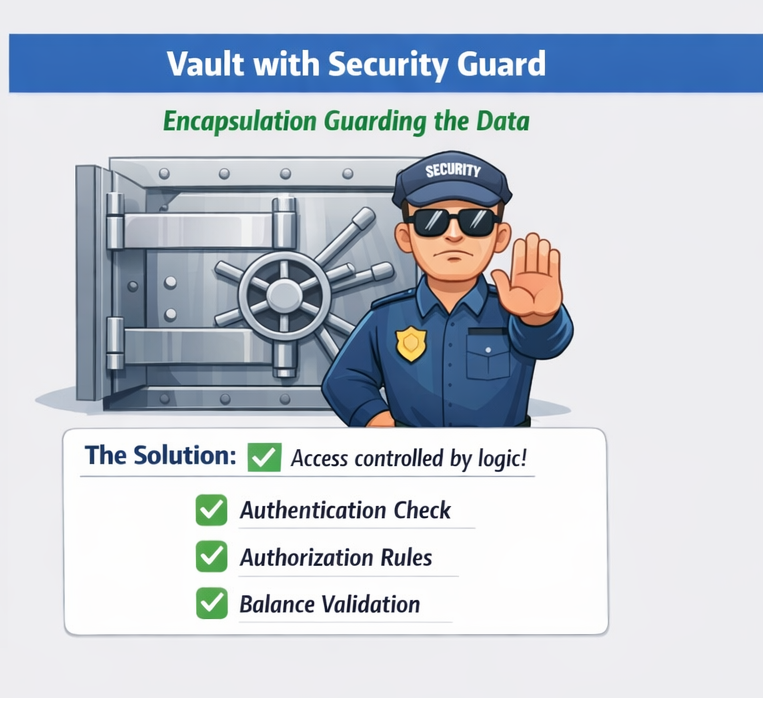
✅ Good Encapsulation
Secure vault with multiple checkpoints. Controlled access with validation.
Real-World Security Implementation
In production banking systems, encapsulation isn’t just about hiding data. It’s about creating security checkpoints before any data access.
Request
withdraw(1000)
Authenticate
Verify Identity
Authorize
Check Permissions
Process
Update Balance
How this translates to Java code: Each step becomes a checkpoint in your method.
public class BankAccount {
    private double balance;

    public boolean withdraw(User user,
            double amount,
            String pin) {

        // CHECKPOINT 1: Authentication
        if (!authenticateUser(user, pin)) {
            return false;
        }

        // CHECKPOINT 2: Authorization
        if (!user.hasPermission("WITHDRAW")) {
            return false;
        }

        // CHECKPOINT 3: Business Rules
        if (amount > balance) {
            throw new InsufficientFundsException();
        }

        balance -= amount;
        logTransaction(user, amount);
        return true;
    }
}
✅ This is REAL Encapsulation:
- Multiple security checkpoints (authentication & authorization)
- Business logic validation before data access
- Comprehensive audit logging for security
- Controlled data modification with proper error handling
- Private helper methods for complex operations
Key Takeaways for Java Beginners
What Encapsulation is NOT:
- Just making variables private
- Simply adding getters/setters
- Only about data hiding
- Basic access modifiers
- A theoretical concept only
What Encapsulation IS:
- Data + Business Logic together
- Security checkpoints in methods
- Controlled access with validation
- Real-world security implementation
- Professional code architecture
The Formula for Good Encapsulation:
private data
+
public methods
+
validation logic
=
Real EncapsulationReady for More Visual Learning?
The encapsulation example above is just 1 of 8 core OOP concepts. Unlock the complete visual learning experience with our premium package.

Polymorphism: One Interface, Many Forms
Visual guide to method overriding, interfaces, and dynamic method dispatch with real-world examples.
Core OOP Interfaces AdvancedInheritance: Code Reuse Hierarchy
Family tree visualization of classes, super() calls, inheritance chains, and method resolution.
Core OOP Code Reuse DesignAbstraction: Simplify Complexity
How abstract classes and interfaces hide implementation details while exposing only essential features.
Core OOP Design ArchitectureCollections Framework Deep Dive
Memory diagrams, performance comparisons, internal implementations, and interview-focused visual guides.
Data Structures Interview PerformanceMaster All 8 OOP Concepts Visually
Upgrade to premium and transform how you learn Java programming with our interactive visual approach
Polymorphism, Inheritance, Abstraction, Composition, Coupling, Cohesion, Interfaces with real examples
Run and visualize code execution with step-by-step breakdowns and real-time debugging
Banking, E-commerce, and Microservices architectures explained visually with code
All-in-One Developer Starter Pack
Limited Time Offer – 90% Discount
