
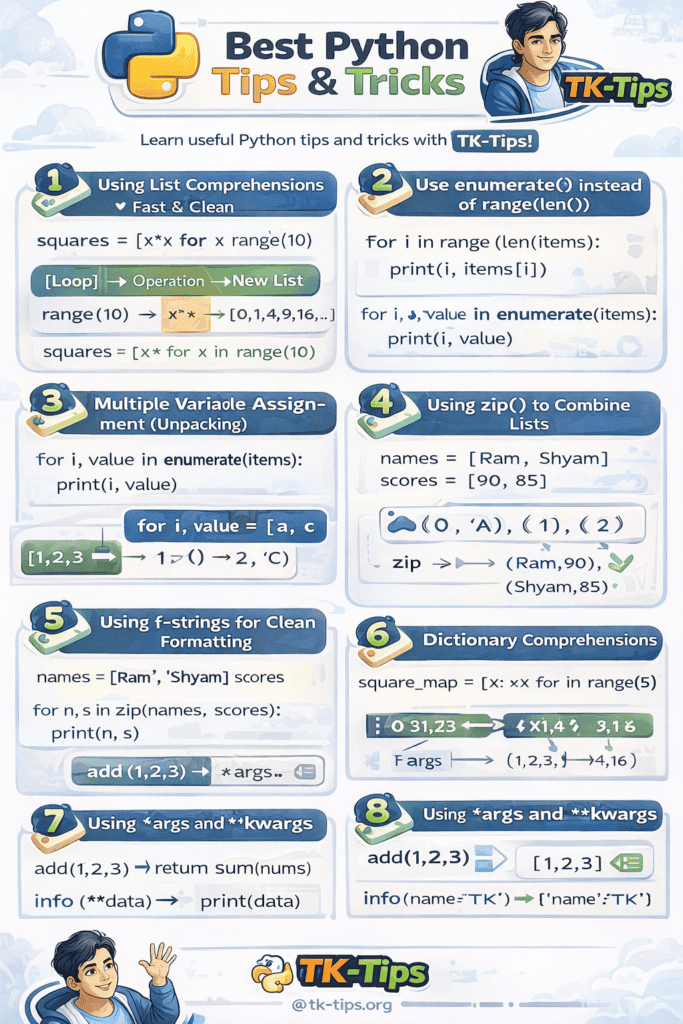
🐍 PYTHON TIPS & TRICKS — WITH SIMPLE VISUAL DIAGRAMS
✅ 1. Using List Comprehensions (Fast & Clean)
🔥 Tip
Instead of writing long loops, use list comprehensions.
Example:
squares = [x*x for x in range(10)]
Visual Diagram:
[Loop] → [Operation] → [New List]

range(10) ──> x*x ──> [0, 1, 4, 9, 16 ...]
✅ 2. Use enumerate() Instead of range(len())
Without enumerate:
for i in range(len(items)):
    print(i, items[i])
With enumerate:
for i, value in enumerate(items):
    print(i, value)
Diagram:
List → enumerate → (index, value) pairs
✅ 3. Multiple Variable Assignment (Unpacking)
a, b, c = 1, 2, 3
Diagram:
[1, 2, 3] → (a, b, c)
Supports:
a, *b = [10, 20, 30, 40]
✅ 4. Using zip() to Combine Lists
names = ["Ram", "Shyam"]
scores = [90, 85]

for n, s in zip(names, scores):
    print(n, s)
Diagram:
names:   [Ram   Shyam]
scores:  [90    85]

zip → (Ram,90), (Shyam,85)
✅ 5. Using f-strings for Clean Formatting
name = "TK"
score = 95
print(f"{name} scored {score} marks")
Diagram:
"{} {} {}".format(...) → ❌ old
f"{var} text" → ✔ new
✅ 6. Dictionary Comprehensions
square_map = {x: x*x for x in range(5)}
Diagram:
for each x → store as {key: value}
0→0, 1→1, 2→4, 3→9, 4→16
✅ 7. Using “in” Keyword for Fast Membership Check
if 'tk' in username:
    print("valid")
Diagram:
String / List / Set
     ↑
 "in" checks membership
✅ **8. Using *args and kwargs
*args → variable number of arguments
def add(*nums):
    return sum(nums)
**kwargs → key-value arguments
def info(**data):
    print(data)
Diagram:
add(1,2,3) → *args → [1,2,3]
info(name='TK') → **kwargs → {'name':'TK'}
✅ 9. Lambda Functions (Inline Mini Functions)
square = lambda x: x*x
print(square(5))
Diagram:
lambda x: x*x
     ↓
Tiny anonymous function
✅ 10. Using map(), filter(), reduce()
map – transform elements
list(map(lambda x: x*2, [1,2,3]))
filter – keep matching elements
list(filter(lambda x: x>2, [1,2,3]))
reduce – accumulate
from functools import reduce
reduce(lambda a,b: a+b, [1,2,3])
Diagram:
[1,2,3] → map → [2,4,6]
[1,2,3] → filter(x>2) → [3]
[1,2,3] → reduce(add) → 6
✅ 11. Using Try/Except in One Line
value = int(input) if input.isdigit() else 0
✅ 12. Use of Set for FAST lookups
unique = set(my_list)
Diagram:
List → (remove duplicates) → Set (Fast O(1))
⭐ BONUS — ADVANCED PYTHON TRICKS
⭐ 13. Swap variables without temp
a, b = b, a
⭐ 14. Merging Dictionaries
d1 = {"a":1}
d2 = {"b":2}
merged = {**d1, **d2}
⭐ 15. Inline If (Ternary)
status = "Pass" if score >= 40 else "Fail"
⭐ 16. List slicing tricks
rev = my_list[::-1]         # reverse
first3 = my_list[:3]        # first 3
last3 = my_list[-3:]        # last 3
⭐ 17. Convert list to string
",".join(["A","B","C"])
⭐ 18. Most useful builtin functions
sorted()any()all()sum()max()min()round()
